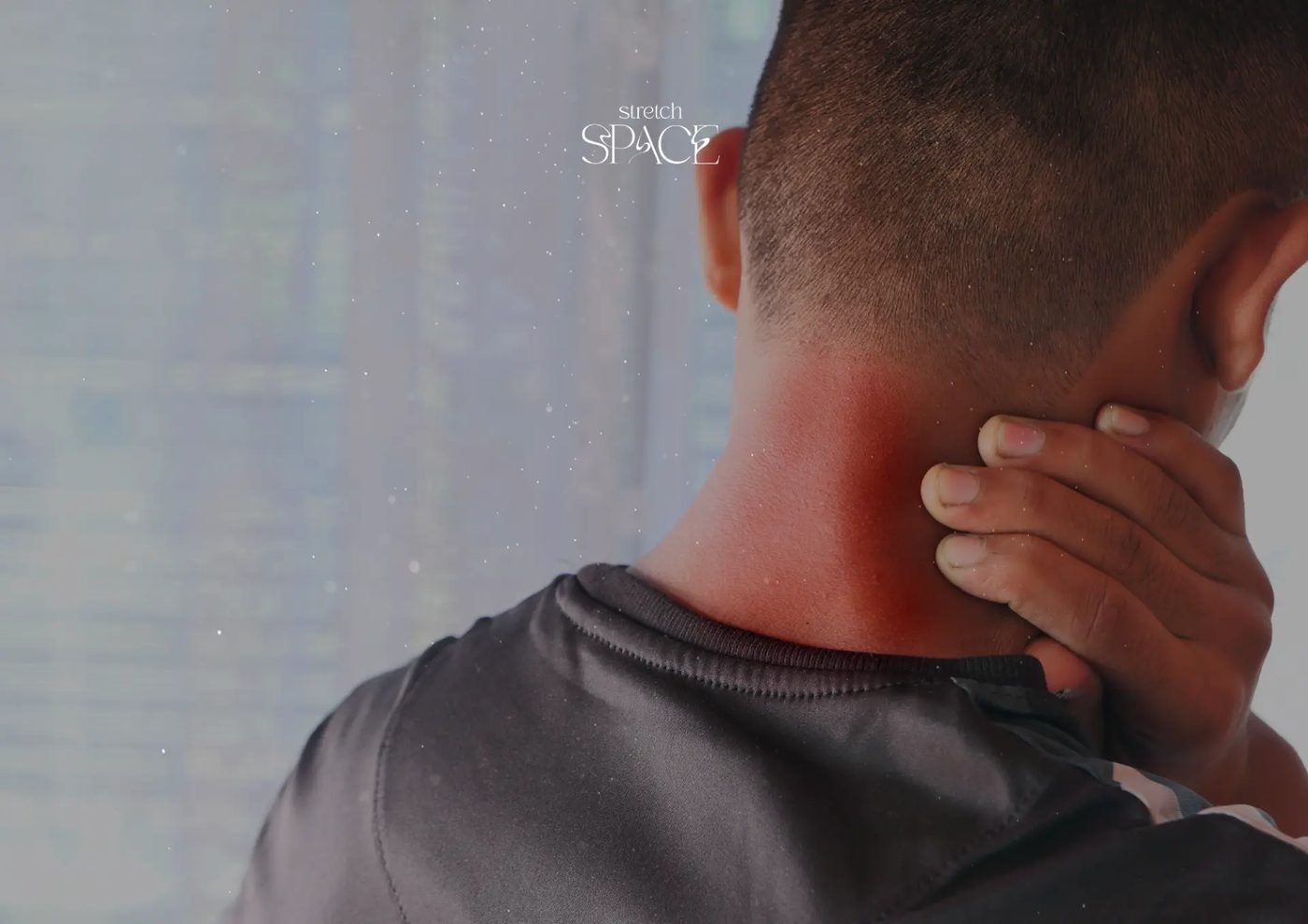
Be honest - did your shoulders just drop a little when you read that title?
Mine did too. It's the most human thing in the world. We hold tension up there without ever deciding to.
How we got here
Think about an average day. You wake up and check your phone in bed, arms forward, chin tucked. You drive, hands at ten and two, shoulders rounded slightly in. You sit at a laptop for hours with your head drifting closer to the screen than you realize. Maybe you text through lunch. Maybe you're in traffic on the 195 with your jaw clenched.
None of that feels dramatic. That's exactly why it adds up.
Your chest and the front of your shoulders spend the whole day in a shortened position. Your upper back - the part that's supposed to rotate and extend - barely moves at all. And your neck, which is a fairly small and delicate piece of the puzzle, ends up carrying the weight of your head in a position it wasn't really designed to hold.
Why rubbing the sore spot doesn't fix it
Here's the part most people miss.
The place you feel tight isn't always the place that needs the attention. Your neck is often the loudest, not the source. When your chest is closed and your mid-back is stiff, your neck is compensating - and it'll keep compensating, no matter how much you massage it, until the rest of you has somewhere else to move.
That's why the relief from digging into your traps lasts about twenty minutes. You quieted the symptom. Nothing around it changed.
What actually helps
Three things, and none of them are complicated.
Open the front of you. Stand in a doorway, forearm on the frame, elbow at about shoulder height, and step gently forward. Breathe for 30 seconds. Switch sides. You'll feel your shoulders settle down on their own - you don't have to force them.
Move your upper back, not just your neck. Sit tall, hands lightly behind your head, and rotate slowly side to side. Small and smooth, not forced. Give your mid-back something to do and your neck gets to stop doing it.
Change positions more often than you think you need to. There's no perfect posture to hold all day. The best position is your next one. Stand up, look up, roll your shoulders, keep moving.
And when you want help
There are positions you genuinely can't get into on your own - and even when you can, it's hard to fully relax when you're the one holding yourself there. That's where assisted stretching is different. You lie down, someone else does the work, and your nervous system finally gets the message that it's okay to let go.
Our 50-minute sessions work through the chest, neck, shoulders, and upper back together, because that's how your body actually works - as one connected thing, not a collection of sore spots.
Most people walk out turning their head further than they did walking in. Some of them didn't even know it had gotten that restricted.
If your shoulders live somewhere near your ears, come see us. We'll help you put them back where they belong.
If you want to go deeper on why neck and shoulder tension becomes your normal, we wrote more about that here. And if your day is mostly a desk, this connects to what sitting does to the rest of the body.