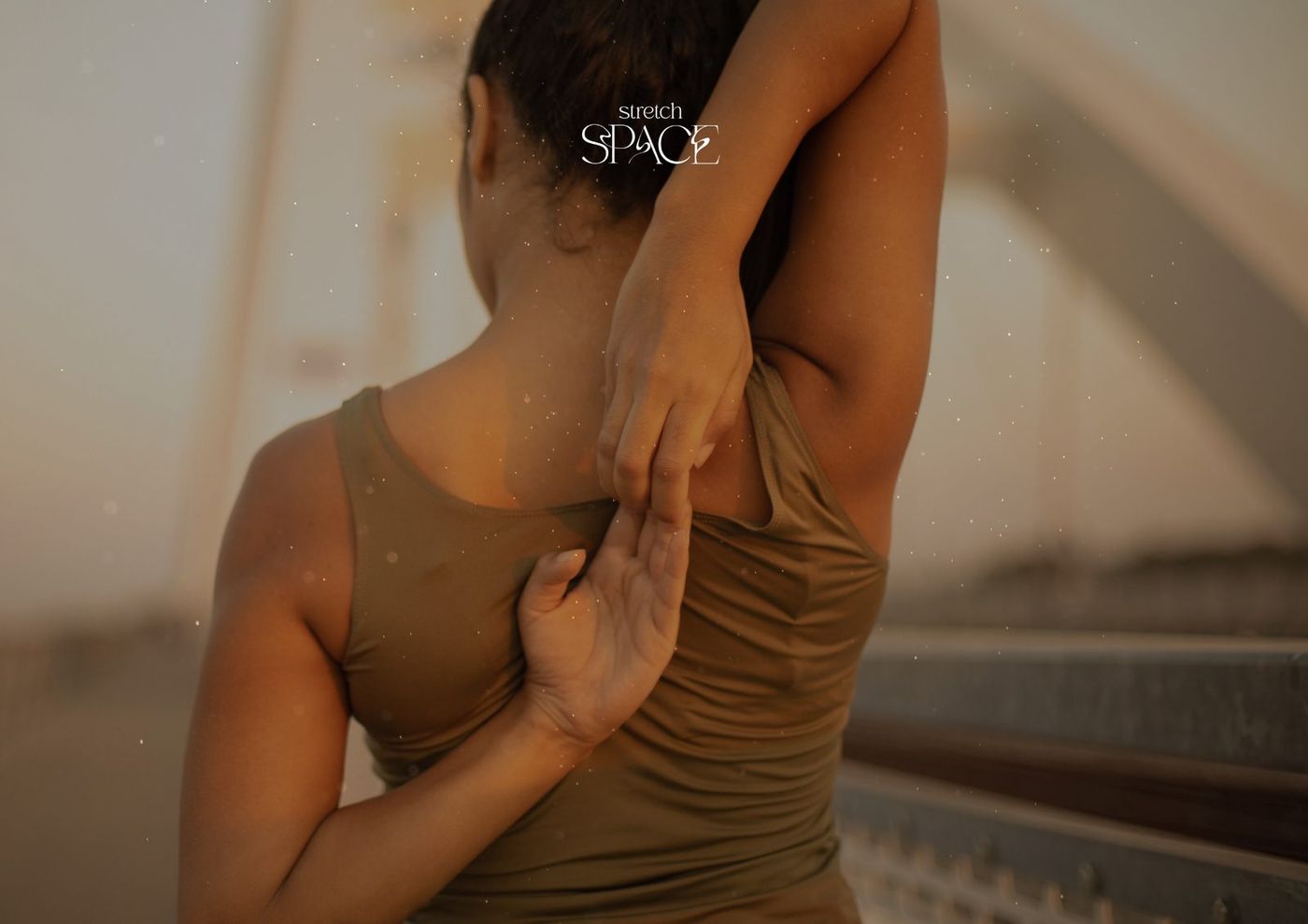
For many people, shoulder tension slowly becomes their normal.
It doesn't announce itself. It accumulates. And then one day someone rests a hand on your traps and you realize you've been holding something up there for months.
Look at where your arms spend their time
Laptop in front of you. Phone in your hand. Steering wheel. Countertop. A bench press. Almost everything we do puts the arms in front of the body, at roughly chest height, for long stretches.
Your shoulders adapt to that. Not dramatically, and not permanently, but enough that the positions you don't visit start to feel unavailable. Reaching overhead. Rotating. Opening across the chest. Taking the shoulder blades genuinely down and back.
By the end of the day, your shoulders may feel like they're creeping toward your ears. Which they might be.
The tight spot isn't the whole story
Almost everyone reaches for the same place: the top of the traps, right where the neck meets the shoulder. It's the loudest area, so it gets all the attention.
But that region is downstream of a lot of things. Your chest and the front of your shoulders influence how far back the shoulder can travel. Your lats affect how easily you get overhead. Your upper back determines how much rotation and extension is available before your neck has to make up the difference.
Working on the loudest spot can feel great. Restoring movement across the whole region is what tends to change how it feels tomorrow.
Breathing is part of it
Something we notice constantly: people arrive at the studio breathing high and shallow, up in the chest and shoulders, and don't realize it until someone points it out.
If your shoulders are participating in every breath you take, that's a lot of low-grade work over the course of a day. Slower breathing that expands the ribs rather than lifting the shoulders is one of the simplest things you can practice, and it costs you nothing.
Don't turn stretching into another workout
There's a tendency to attack tension. Dig harder, stretch deeper, really get in there.
Upper body tension in particular tends not to respond well to force. It responds to time, gradual range, and an intensity that doesn't make you tense up somewhere else just to tolerate it.
At Stretch Space, we use assisted stretching and mobility techniques to explore those restrictions gradually, without turning stretching into another thing you have to fight through. Your specialist can work the chest, shoulders, upper back and neck region in one session, adjusting as they go based on what they feel.
If your day involves a desk, this connects directly to what sitting does to the rest of the body. And if you've wondered why being stretched feels so different from stretching yourself, we get into that here.