The problem with sitting isn't that sitting is bad.
Sitting is a position. Positions are fine. The issue is that many of us hold one of them for eight, ten, sometimes twelve hours while asking our bodies to use almost none of the movement they're capable of.
What ten hours of one shape does
Your hips stay bent at roughly the same angle. Your arms stay forward. Your upper back barely changes position. Your neck holds your head at whatever angle your screen demands. Your feet do essentially nothing.
Then you stand up at the end of the day and wonder why everything feels stiff.
It isn't that any of those positions harmed you. It's that your body got very little input, in very few directions, for a very long time, and it's now telling you about it.
Movement variety beats a single stretch
A five-minute stretch at the end of the day is useful. It's also five minutes against ten hours, which is not a fair fight.
What tends to help more is breaking up the sameness. Small, frequent, unremarkable movement scattered through the day:
- Stand up every 30 to 45 minutes, even briefly. Set a timer if you need one.
- Take one walk that isn't to the kitchen. Even five minutes changes the input.
- Open your hips with a standing hip flexor stretch or a low lunge while your coffee brews.
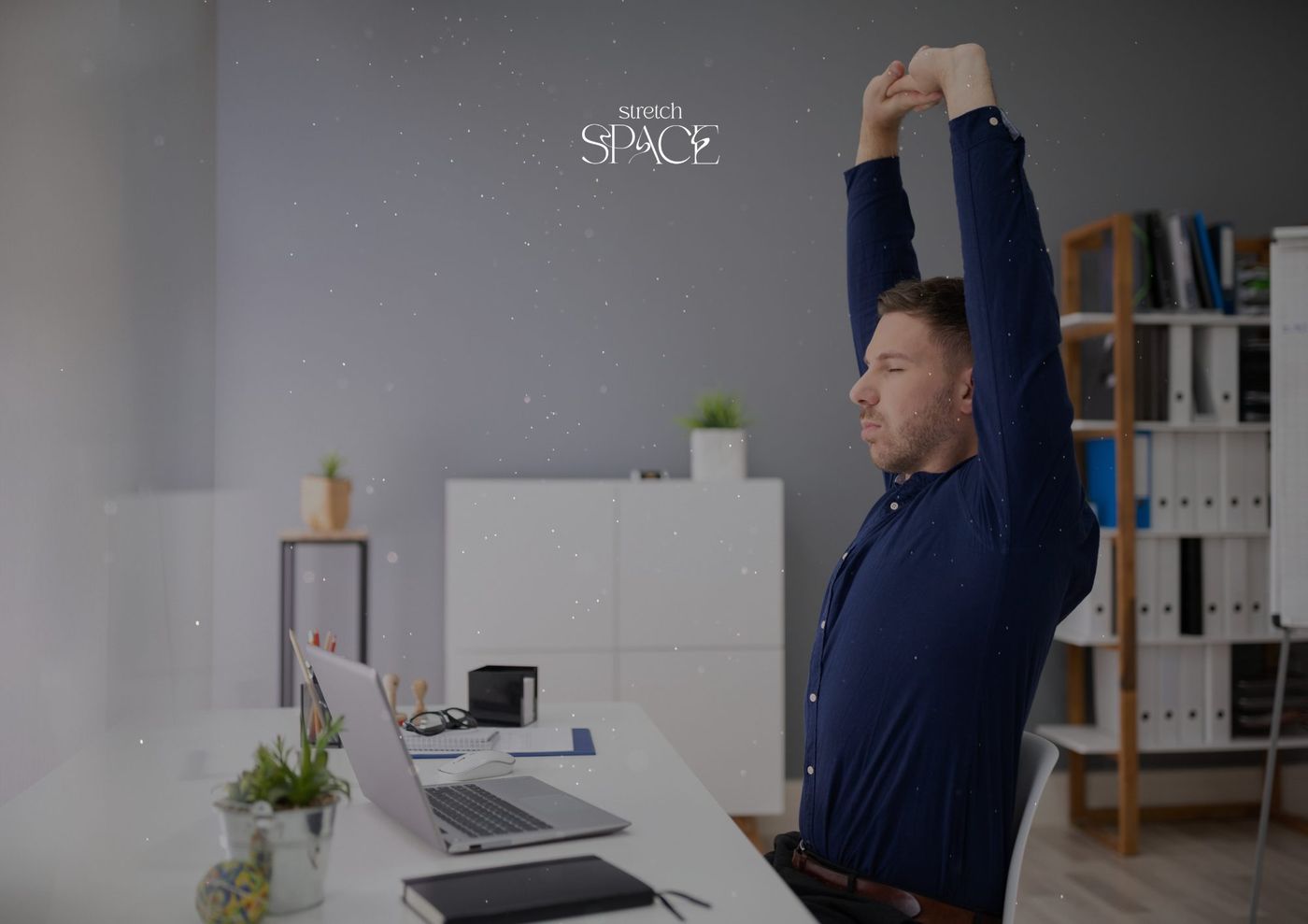
- Reach overhead with both arms, a few times, slowly. Most people barely go overhead all day.
- Rotate. Turn your upper body left and right in your chair. Your spine is built to twist and rarely gets asked to.
- Change how you sit. Different chair, different height, occasionally standing. Variety beats hunting for one perfect posture.
- Take your shoulder blades down and back a few times an hour, especially if you've been on your phone.
None of that is impressive. That's the point. It's meant to be small enough that you actually do it.
Where deeper work fits
Those small habits handle daily maintenance. They don't do much for areas that have been restricted for years and are hard to reach on your own.
That's where assisted stretching earns its place. It gives you dedicated time to work through the hips, upper back, shoulders and hamstrings with someone else controlling the position, so you can get into ranges that are genuinely difficult to access alone.
Think of it as the difference between brushing your teeth and going to the hygienist. You need both, and one doesn't replace the other. On the question of how often, we've written about that here.